A spring snaps. A panel dents. An opener stops responding after a power surge. You call for a repair, and then you hear it: this part is not covered under warranty. Most homeowners only find out what their garage door warranty actually says the day something breaks, and by then it is too late to change the outcome.
This is a common problem, and it is avoidable. Garage door warranties are not all the same. Coverage varies by manufacturer, by component, and by how the door was installed. Some warranties last a lifetime on the door panels but only a year on labor. Others cover parts fully but exclude damage caused by weather or improper maintenance. Reading the fine print before a problem happens puts you in control instead of leaving you surprised.
This guide breaks down how garage door warranties actually work, what they typically cover, what they usually exclude, and how to handle a claim without losing coverage you are entitled to.
Why Garage Door Warranties Matter More Than Most People Think
A garage door is a mechanical system with moving parts under constant tension. Springs stretch and compress thousands of times a year. Openers run motors that wear down with use. Panels face sun, rain, and daily temperature swings. Because of this, garage doors fail differently than static building materials like siding or roofing.
A warranty is the manufacturer’s promise about how long specific components should last under normal use. It sets expectations for durability, and it protects the homeowner from paying full price twice for a product defect that was not their fault. Without a warranty, any early failure becomes the homeowner’s expense, even if the failure was caused by a manufacturing flaw rather than misuse.
Understanding warranty terms also affects buying decisions. A door with a strong limited lifetime warranty on hardware often signals a manufacturer’s confidence in that component. A door with a short warranty period on major parts can be a signal to ask more questions before purchase.
How Garage Door Warranties Are Structured
Most manufacturer warranties are not a single blanket policy. They are broken into layers, and each layer covers a different part of the door system for a different length of time.
Coverage by Component
Garage doors are made of several distinct parts, and warranties usually treat each one separately. The door panels, the hardware, the springs, and the opener each carry their own coverage terms, often from different manufacturers entirely, since the door and the opener are frequently made by separate companies.
Brands like Clopay, Wayne Dalton, and Amarr manufacture the door panels and structural hardware. LiftMaster, on the other hand, is one of the most common opener manufacturers, and its warranty terms apply only to the motor unit and its electronic components, not the door itself. This distinction catches many homeowners off guard during a claim, since they assume one warranty covers the entire system.
Original Owner Versus Transferable Coverage
Another detail buried in most warranty documents is whether coverage transfers to a new homeowner if the property is sold. Many manufacturer warranties are written for the original purchaser only, and the coverage period shortens or ends entirely once ownership changes hands. A homebuyer who inherits a garage door installed by a previous owner should not assume the original lifetime warranty still applies in full. Checking this detail during a home purchase, or asking the seller for the original installation paperwork, can prevent a false assumption about coverage later.
Regional Factors That Affect Warranty Performance
Warranty terms are usually written the same way nationwide, but how quickly a homeowner reaches the limits of that warranty can depend heavily on local conditions. In South Florida and Southwest Florida, higher humidity and salt exposure near the coast accelerate corrosion on hardware and components in ways that inland climates do not experience at the same rate. A hinge or roller that might last well beyond its warranty period in a dry climate can reach the edge of normal wear sooner in a coastal environment. This does not change what the warranty covers, but it does mean coastal homeowners are more likely to encounter maintenance related exclusions if upkeep is not consistent.
Coverage Period
Warranty length depends on the component. Door panels often carry the longest coverage, sometimes marketed as a limited lifetime warranty, which usually applies to the steel or aluminum panel itself against rust-through or structural failure under normal conditions. Springs typically carry a shorter period, often measured in cycles rather than years, since springs wear out through repeated use rather than age alone. Openers usually carry a coverage period between one and five years for parts, with motor coverage sometimes extending longer depending on the model.
Labor Warranty
This is one of the most misunderstood parts of any garage door warranty. A parts warranty covers the cost of the replacement component. A labor warranty covers the cost of the technician’s time to install that replacement part. These are often separate, and a labor warranty is almost always shorter than the parts warranty attached to the same component.
A homeowner can have a lifetime warranty on a door panel but only a one year labor warranty. If the panel fails in year three, the replacement panel itself may be free, but the labor to remove the old panel and install the new one will likely be billed separately.
What Is Typically Covered Under a Garage Door Warranty
At a glance, standard manufacturer warranties usually protect against:
- Manufacturing defects in materials or workmanship
- Structural failure or rust-through on panels, when not caused by impact
- Motor and circuit board failure on the opener, within the coverage period
- Springs and hardware that fail within their rated cycle limits
Manufacturer Defects
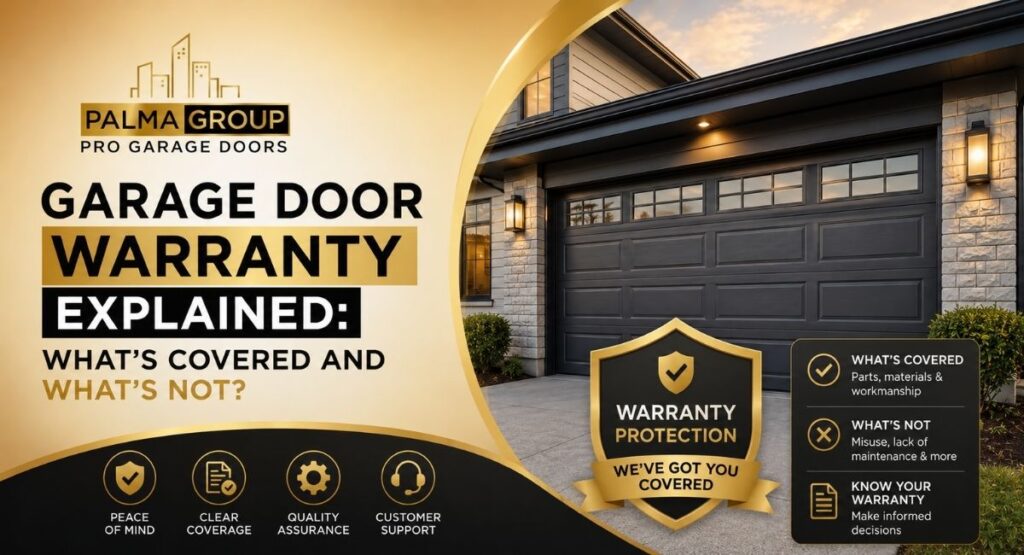
This is the core purpose of any warranty. If a door panel, spring, track, or opener component fails due to a flaw in materials or workmanship, rather than misuse or external damage, the manufacturer warranty is designed to cover it. This includes issues like premature rust on a properly coated panel, a motor that fails without any sign of external damage, or hardware that breaks under normal operating conditions.
Structural Integrity of Panels
Most limited lifetime warranties on steel or aluminum panels cover structural failure and rust-through, meaning the panel rusting from the inside out due to a manufacturing defect rather than external damage. This does not typically include surface rust caused by chipped paint from an impact, since that falls under damage rather than defect.
Opener Electronics and Motor
LiftMaster and similar opener manufacturers typically cover the motor and main circuit board against failure during the warranty period, provided the unit was installed correctly and used within its rated specifications. Battery backup units and remote controls sometimes carry separate, shorter warranty terms.
Springs and Hardware Within Cycle Limits
Torsion and extension springs are often warrantied based on a cycle count, such as ten thousand or twenty thousand cycles, rather than a flat number of years. One cycle equals one full open and close movement. A door used multiple times daily will reach its spring’s cycle limit faster than a door used occasionally, which means two identical doors in different households may need garage door spring replacement at very different times, even under the same nominal warranty.
What Is Typically Not Covered
Most garage door warranties share a common set of exclusions, even though the exact wording varies by manufacturer:
- Damage from wind, storms, flooding, or debris impact
- Failures caused by improper or unlicensed installation
- Corrosion or wear caused by lack of routine maintenance
- Normal wear and tear, such as faded paint or cosmetic scratches
- Aftermarket parts or unauthorized modifications
- Commercial use of a door rated for residential cycles
Each of these exclusions is worth understanding in more detail, since the reasoning behind them affects how a claim will be evaluated.
Damage From Weather Events
This is one of the most important exclusions for Florida homeowners to understand. Manufacturer warranties generally do not cover damage from wind, storms, flooding, or debris impact. A garage door that buckles during a hurricane, even one with a proper wind rating, is typically considered storm damage rather than a product defect, and most standard manufacturer warranties exclude this kind of failure. Homeowners insurance, not the manufacturer warranty, is usually the correct avenue for storm related damage claims.
Improper Installation
If a door was installed incorrectly, whether by an unlicensed installer or through a do it yourself attempt, most manufacturers will void the warranty on the affected components. This is because improper installation puts uneven stress on panels, tracks, and springs, which can cause failures that look like defects but are actually installation errors. This is one reason professional installation matters, since it protects both the safety of the system and its warranty eligibility.
Lack of Maintenance
Warranties assume a baseline level of upkeep. Rollers that seize from lack of lubrication, hinges that corrode from neglected coastal exposure, or tracks that bend from accumulated debris are generally treated as maintenance failures rather than manufacturing defects. A consistent maintenance routine protects both the door’s performance and its warranty standing.
Normal Wear and Tear
Some level of wear is expected over a door’s lifespan, and warranties are not designed to cover routine aging. Faded paint from years of UV exposure, minor surface scratches, or hardware that shows cosmetic wear after a decade of use typically falls outside warranty coverage, even on a door still within its nominal coverage period.
Third Party Parts and Modifications
Installing aftermarket components, replacing an opener with a different brand’s remote system, or modifying the door’s structure can void portions of the original warranty. Manufacturers test their warranties against their own parts working together, and introducing outside components breaks that chain of accountability.
Commercial Use of a Residential Door
A residential garage door used in a commercial setting, such as a business that opens and closes the door dozens of times daily, often exceeds the cycle expectations built into a residential warranty. Using a residential rated door commercially can shorten or void coverage, since the warranty was calculated around residential use patterns.
Comparing Typical Warranty Coverage by Component
| Component | Typical Coverage Length | Common Exclusions |
| Steel or aluminum panels | Limited lifetime on rust-through and structural defects | Impact damage, storm damage, chipped paint corrosion |
| Springs | Cycle based, often 10,000 to 20,000 cycles | Wear from heavy daily use beyond rated cycles |
| Opener motor and electronics | 1 to 5 years, sometimes longer on motor only | Power surge damage, improper installation, water intrusion |
| Hardware (hinges, rollers, tracks) | 1 to 10 years depending on manufacturer | Corrosion from lack of maintenance, coastal exposure without upkeep |
| Labor | Often 1 year, separate from parts coverage | Labor after the labor warranty period expires |
Warranty Registration and Why It Matters
Many manufacturers require warranty registration to activate full coverage. This usually involves submitting the installation date, model number, and sometimes the installer’s information within a set window after installation, often thirty to ninety days.
Skipping this step does not always void the warranty completely, but it can complicate a future claim, since the manufacturer has no record of when the coverage period began. Keeping a copy of the installation invoice, the door’s model and serial number, and the registration confirmation in one place makes any future claim faster and easier to process.
How to File a Garage Door Warranty Claim
Filing a claim correctly improves the chances of a smooth resolution.
Step One: Identify the Failed Component
Before contacting anyone, confirm which part actually failed. A door that will not open could be a spring issue, an opener issue, or a track issue, and each falls under a different warranty and sometimes a different manufacturer entirely.
Step Two: Gather Documentation
Locate the original installation invoice, the door’s model and serial number, and any warranty registration confirmation. If the installer is still in business, contacting them first is usually the fastest path, since they can often verify installation details directly with the manufacturer.
Step Three: Contact the Correct Manufacturer
Since panels, springs, and openers are sometimes made by different companies, a single door failure may require contacting more than one manufacturer if multiple components are involved. Clopay, Wayne Dalton, and Amarr each have their own warranty claim process for structural components, while LiftMaster handles claims specific to opener hardware.
Step Four: Schedule an Inspection
Most warranty claims require a technician to confirm the failure is due to a covered defect rather than an excluded cause like impact damage or lack of maintenance. This inspection step is standard and protects both the homeowner and the manufacturer from disputed claims.
Step Five: Understand What You Will Pay
Even with a valid parts warranty, labor costs may not be covered if the labor warranty period has expired. Knowing this ahead of time prevents confusion when the final invoice includes a labor charge despite a free replacement part.
A Real World Example
A homeowner in a coastal Florida neighborhood noticed a torsion spring had snapped after several years of daily use. The panel manufacturer’s warranty did not apply, since the spring was a separate component with its own cycle based coverage. After checking the original invoice, the homeowner found the spring was still within its rated cycle count, and the manufacturer approved a parts replacement at no cost.
However, the labor warranty on that spring had expired a year earlier, so the homeowner paid for the technician’s time even though the part itself was free. This is a common outcome, and understanding the difference between parts and labor coverage in advance would have set the right expectation before the appointment. Anyone dealing with a similar issue can review a straightforward guide on how to replace a garage door spring to understand what the process typically involves before a technician arrives.
How Maintenance Protects Your Warranty
Regular maintenance is one of the simplest ways to keep a warranty valid and to catch problems before they become full failures. Lubricating rollers and hinges, checking spring tension, and inspecting the bottom seal are small tasks that prevent larger issues tied to neglect. Homeowners who want a clear routine can follow a garage door maintenance checklist to stay ahead of the kind of wear that manufacturers typically exclude from coverage.
Cost is another factor worth understanding alongside warranty terms, since not every repair will be covered even under an active warranty. Reviewing typical garage door repair cost in Florida figures gives a realistic picture of what to expect when a repair falls outside covered terms.
When a Warranty Claim Turns Into a Replacement Decision
Sometimes an inspection reveals that a door has reached the end of its practical lifespan rather than experiencing a single covered defect. Repeated spring failures, multiple hardware issues, or an opener that has failed more than once even after warranty repairs can signal that a full replacement is more practical than continued repairs. In these cases, understanding the process behind a new garage door installation in Florida helps set realistic expectations for cost, timeline, and the warranty terms that will apply to the replacement door.
Homeowners weighing this decision sometimes also review how a new garage door upgrade home’s value, since a full replacement carries benefits beyond just resolving warranty related frustration.
Common Warranty Mistakes Homeowners Make
A few recurring mistakes account for most denied or delayed warranty claims:
- Ignoring registration deadlines. This can delay or complicate a future claim, since the manufacturer has no confirmed record of the installation date.
- Assuming the door and opener share one warranty. These are usually separate products from separate manufacturers, each with its own terms.
- Skipping routine maintenance. This quietly voids coverage over time, since most warranties assume basic upkeep as a condition of validity.
- Using unlicensed or inexperienced installers. This can void structural warranties immediately, even if the homeowner is unaware of it at the time.
- Overlooking the labor warranty terms. Many homeowners assume labor is covered for the same length as parts, then get an unexpected bill.
Frequently Asked Questions
Does a garage door warranty cover hurricane or storm damage?
No, most manufacturer warranties exclude storm and weather related damage. This type of damage typically falls under homeowners insurance rather than the product warranty.
Are the garage door and the garage door opener covered under the same warranty?
Usually not. The door panels and hardware are typically covered by the door manufacturer, such as Clopay, Wayne Dalton, or Amarr, while the opener is covered separately by its own manufacturer, such as LiftMaster.
What happens if I do not register my garage door warranty?
Coverage may still apply in many cases, but registration provides documented proof of the installation date and can make future claims faster and easier to process.
Does DIY installation void the warranty?
In most cases, yes. Manufacturers typically require professional installation to keep structural and hardware warranties valid, since improper installation can cause stress related failures that mimic defects.
How long do garage door springs typically last under warranty?
Spring warranties are usually based on cycle counts rather than years, often between ten thousand and twenty thousand cycles, so actual lifespan depends on how often the door is used.
Is labor always included in a garage door warranty?
Not always. Labor warranties are often shorter than parts warranties and may expire well before the parts coverage does, which can result in a free part but a billed labor charge.
Final Takeaway
A garage door warranty is only useful if you understand what it actually protects. Coverage is typically split between the door panels, hardware, springs, and the opener, each with its own terms and each often from a different manufacturer. Weather damage, improper installation, and routine wear generally fall outside standard coverage, while manufacturing defects within the rated component and cycle limits are usually protected.
Reading the fine print before a problem happens, registering your warranty promptly, and keeping up with basic maintenance are the simplest ways to make sure a warranty actually works for you when you need it.
If you are unsure what your current garage door warranty covers, or if you are dealing with a failure and want a clear answer on whether it qualifies for a claim, Palma Group Pro Garage Doors can review your door, check your coverage, and walk you through the right next step. Our team serves homeowners throughout South Florida and Southwest Florida, including Naples, Garage Door repair in Coconut Creek, FL, and Golden Gate Estates, and can help you avoid paying for something your warranty was already meant to cover.