Your garage door opens and closes a few thousand times a year without much thought from you, until the day it stops moving altogether. Maybe it groans on the way up. Maybe it hangs crooked on one side. Maybe it just sits there, unresponsive, while you’re already late for work.
At that point, most homeowners ask the same question: is this door old enough to replace, or is something simple broken?
The answer depends on what the door is made of, how it has been maintained, and what kind of weather it has been fighting for years. In South Florida and Southwest Florida, that weather includes salt air, heavy humidity, intense UV exposure, and storm season, all of which push garage doors harder than they push doors in milder climates.
This guide breaks down the average lifespan of garage doors by material, what actually wears them out, and how to tell whether your door still has years left or is quietly counting down to failure.
Why Garage Door Lifespan Actually Matters
A garage door is one of the largest moving parts of a home, and often the largest single entry point. When it works properly, it protects vehicles, tools, and storage from weather and intrusion. When it starts failing, the risks go beyond noise and inconvenience.
An aging door can put stress on its opener, cause springs to wear unevenly, and in worst cases, fail while in motion. A few risks tend to show up as a door nears the end of its service life:
- More frequent repair calls, often for different parts each time
- Higher energy loss if the insulation or seals have degraded
- Reduced home security if panels, locks, or tracks are compromised
- Unexpected downtime, especially during storm season when the door is needed most
Understanding roughly where your door sits in its lifecycle helps you plan a budget instead of reacting to a breakdown.
There’s also a home value angle worth mentioning briefly. A garage door in good condition affects curb appeal and buyer perception more than most homeowners realize, something covered in more detail in this guide on how does a new garage door increase home value.
Average Garage Door Lifespan: The Quick Answer
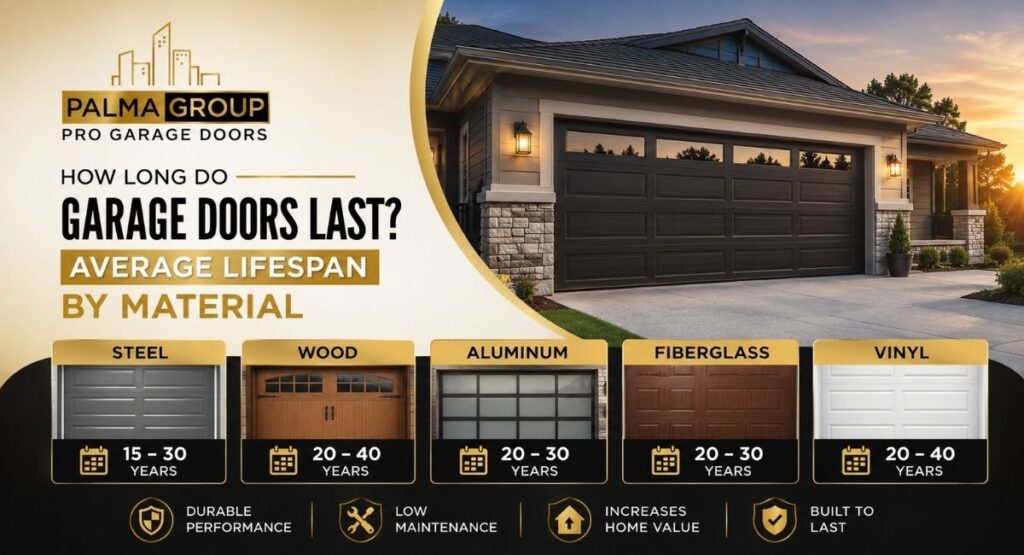
Most residential garage doors last between 15 and 30 years, depending on material, climate exposure, and maintenance habits. That’s a wide range, and the material makes most of the difference.
The table below gives a general starting point. Individual results vary based on usage, climate, and upkeep.
| Material | Average Lifespan | Best Suited For |
| Steel | 20 to 30 years | Coastal and humid climates, low maintenance needs |
| Wood | 15 to 20 years | Curb appeal, custom design, drier climates |
| Aluminum | 15 to 25 years | Lightweight applications, resistance to rust |
| Fiberglass | 15 to 20 years | Coastal humidity, low warping risk |
| Vinyl | 20 to 25 years | Impact resistance, minimal upkeep |
These figures reflect the Door and Access Systems Manufacturers Association (DASMA), an industry body that publishes guidance on the expected service life and performance standards for residential and commercial doors. DASMA numbers are useful as a baseline, but actual lifespan still depends heavily on local conditions and how well the door has been cared for over the years.
Garage Door Lifespan by Material
Steel Garage Doors
Steel is the most common residential garage door material, and for good reason. It holds up well against impact, resists warping, and comes in a wide range of styles and insulation options. A well maintained steel door typically lasts 20 to 30 years.
The main threat to steel door lifespan in Florida isn’t the steel itself, it’s rust. Panels near the bottom of the door, where water pools during storms, are the first to show corrosion if the finish gets scratched or chipped. Manufacturers like Clopay build many of their steel lines with galvanized coatings and baked on finishes specifically to slow this process, but no coating lasts forever without upkeep.
Insulated steel doors, which sandwich a layer of polystyrene or polyurethane between two steel skins, tend to outlast single layer steel doors because the insulation reduces condensation buildup on the interior panel.
Wood Garage Doors
Wood doors bring a level of curb appeal that steel and aluminum can’t fully replicate, but they demand more attention. Average lifespan sits around 15 to 20 years, and that number drops significantly if the door isn’t refinished on a regular schedule.
Humidity is the biggest factor here. Wood absorbs and releases moisture with the seasons, which causes swelling, shrinking, and eventually warping or cracking if the sealant isn’t reapplied every few years. In coastal and humid regions, wood doors need refinishing roughly every two to three years to hold their lifespan expectations. Skip that maintenance, and a wood door can start showing structural issues in half that time.
Aluminum Garage Doors
Aluminum doors are lightweight, which reduces strain on springs and openers, and they don’t rust the way steel can. Expected lifespan runs 15 to 25 years. The tradeoff is that aluminum dents more easily than steel, and repeated impacts, from a bike, a car bumper, or storm debris, can shorten a door’s usable life well before other components wear out.
Aluminum performs particularly well in coastal Florida settings where salt exposure would otherwise accelerate corrosion on unprotected steel.
Fiberglass Garage Doors
Fiberglass doors are built around a steel or aluminum frame with a fiberglass skin, giving them resistance to denting and cracking along with decent humidity tolerance. They typically last 15 to 20 years. Over time, prolonged UV exposure can cause the surface to become brittle or discolored, so doors that face direct afternoon sun for most of the day tend to show wear earlier than shaded installations.
Vinyl Garage Doors
Vinyl doors are less common but worth mentioning, since they’re a strong option for households prioritizing minimal upkeep. They resist denting, don’t rust, and won’t rot. Average lifespan runs 20 to 25 years, with UV fading being the main long term cosmetic concern rather than structural failure.
What Shortens Garage Door Lifespan
Material sets the baseline, but real world lifespan depends heavily on the conditions a door faces every day. A few factors matter more than people expect:
- Local climate, especially humidity and salt air near the coast
- How often the door is opened and closed each day
- Exposure to storms, wind pressure, and flying debris
- Whether preventive maintenance is done on a regular schedule
Climate and Humidity
South Florida and Southwest Florida homes deal with year round humidity, salt laden air near the coast, and intense summer heat. These conditions accelerate rust on steel components, warping on wood, and seal degradation across every material type. Doors installed in coastal zones generally need closer inspection schedules than doors further inland.
Usage Frequency
A door that opens and closes eight to ten times a day wears differently than one used twice a day. Higher usage means faster wear on rollers, hinges, and cables, even if the panels themselves hold up fine. Households working from home, running home businesses out of a garage, or with multiple drivers tend to see component wear sooner.
Storm and Impact Exposure
Hurricane season brings wind pressure, flying debris, and heavy rain that test every seal and panel on a garage door. Doors not rated for wind resistance in storm prone areas face a higher risk of panel damage, track misalignment, and seal failure after major weather events.
Lack of Preventive Maintenance
This is the factor homeowners have the most control over. Lubrication, hardware inspection, and weatherstripping replacement all extend the practical life of a door regardless of material. A consistent maintenance routine, like the one outlined in this checklist for garage door maintenance, is one of the simplest ways to avoid early replacement.
Signs Your Garage Door Is Reaching the End of Its Lifespan
Not every issue means a full replacement is coming, but a pattern of recurring problems usually signals the door is aging out rather than experiencing a one off failure.
Watch for these patterns:
- Repairs becoming more frequent over a short period
- Visible rust, rot, or warping on panels
- Increased noise during operation, especially grinding or scraping
- Sagging sections or gaps in the seal along the bottom
- Slower response time from the opener, even after opener maintenance
- Difficulty balancing the door, where it drifts open or shut on its own
A single symptom might point to a worn part rather than a dying door. A cluster of them, especially combined with the door’s age, is a stronger signal. This breakdown of the top signs your garage door needs repair goes into more detail on how to read these warning signs correctly.
Component Lifespan: Why Parts Wear Out Before the Door Does
A garage door isn’t one single object with one single lifespan. It’s a system of parts, and several of them wear out well before the panels themselves need replacing.
| Component | Typical Lifespan | Common Failure Sign |
| Torsion springs | 7 to 12 years (10,000 to 15,000 cycles) | Loud bang, door won’t lift evenly |
| Cables | 8 to 10 years | Fraying, door hangs crooked |
| Rollers | 7 to 10 years | Grinding noise, jerky movement |
| Opener motor | 10 to 15 years | Slow response, frequent resets |
| Weatherstripping | 3 to 5 years | Drafts, water intrusion at the base |
Replacing these components on schedule, rather than waiting for total failure, is often what separates a door that lasts 30 years from one that needs early replacement. Spring failure in particular is one of the more urgent issues, since a broken spring puts sudden strain on the opener and cables. If your springs are showing wear, a professional garage door broken spring replacement resolves the issue before it cascades into bigger repairs. Cable wear tends to follow a similar pattern, and worn cables rarely fail in isolation from spring tension issues.
Repair or Replace: How to Decide
This is usually the real question behind “how long do garage doors last.” A homeowner doesn’t need the textbook answer, they need to know what to do with their specific door right now.
A general rule of thumb: if repair costs are approaching 50 percent of what a new door would cost, or if the door is over 15 years old and needs a major component replaced, replacement usually makes more financial sense than continuing to patch it. Understanding typical repair pricing helps put that comparison in perspective, and this guide on garage door repair cost in Florida breaks down what different fixes tend to run.
On the other hand, a door under 10 years old with a single failed component, like a spring or a roller, almost always makes sense to repair rather than replace. The panels, frame, and track usually still have plenty of service life left, and swapping one part is far cheaper than a full replacement.
If you do decide replacement is the right move, a new installation also resets the clock on warranty coverage. Reviewing how manufacturer and installer warranties work is worth doing before deciding on a door, and this garage door warranty guide explains what’s typically covered and for how long.
Extending the Life of Your Garage Door
A few habits make a measurable difference over the years, regardless of material.
Lubricate moving parts twice a year. Rollers, hinges, and springs need lubrication to reduce friction related wear. This is especially important in humid climates where moisture accelerates corrosion on unprotected metal.
Inspect weatherstripping annually. The rubber seal along the bottom of the door keeps water and pests out. Once it cracks or flattens, it should be replaced before it lets moisture reach the panel or flooring underneath.
Rebalance the door periodically. A door that isn’t balanced correctly puts extra strain on the opener motor. A simple test: disconnect the opener and lift the door manually. It should stay in place at about waist height. If it doesn’t, the springs likely need adjustment.
Repaint or reseal wood doors on schedule. As covered earlier, this is the single biggest factor in wood door longevity.
Address small issues immediately. A slightly frayed cable or a squeaky roller rarely fixes itself. Left alone, small issues tend to accelerate wear on the parts around them, which is part of why a full maintenance checklist is worth following on a set schedule rather than only after something breaks.
Choosing a Replacement Door Built for Florida Conditions
If your current door is approaching the end of its expected lifespan, choosing the right replacement matters more in Florida than in most other regions. Wind load ratings, corrosion resistant hardware, and proper insulation all affect how long the next door will actually last, not just what the spec sheet claims.
Manufacturers like Clopay and Wayne Dalton offer steel and insulated lines built specifically with coastal and hurricane prone regions in mind, including reinforced panels and wind load certifications suited to South Florida building codes. A professional new garage door installation in Florida also ensures the door is properly balanced and sealed from day one, which affects long term performance more than most homeowners realize.
Garage Door Lifespan FAQs
How long do garage doors typically last in Florida?
Most garage doors last between 15 and 25 years in Florida, though steel and vinyl doors on the higher end of maintenance can reach 30 years. Coastal humidity and salt exposure tend to shorten lifespan compared to inland or drier climates.
Do insulated garage doors last longer than non insulated ones?
Generally yes. Insulated steel doors reduce interior condensation, which slows corrosion on the inner panel and helps the door hold its structural integrity longer.
Is it cheaper to repair or replace an old garage door?
It depends on the door’s age and the scope of the repair. A single component fix, like a spring or roller, is almost always cheaper than replacement. Multiple recurring repairs on a door over 15 years old usually tip the math toward replacement.
How often should garage door springs be replaced?
Torsion springs typically last 7 to 12 years, or around 10,000 to 15,000 open and close cycles, whichever comes first. Heavy daily use shortens that window.
Can a garage door last 30 years?
Yes, particularly steel or vinyl doors with consistent maintenance and moderate usage. Reaching that upper range usually requires regular lubrication, prompt weatherstripping replacement, and timely spring and cable servicing along the way.
Does the garage door opener affect the door’s lifespan?
Indirectly, yes. An opener that’s out of sync with the door’s balance forces the motor and door hardware to work harder than necessary, which accelerates wear on springs, cables, and rollers over time.
Final Takeaway
Garage door lifespan isn’t a fixed number, it’s a range shaped by material, climate, and how consistently the door gets maintained. Steel and vinyl doors tend to hold up longest in Florida’s humidity and salt air, while wood requires more hands on care to reach its full potential lifespan. Components like springs, cables, and rollers wear out well before the door itself, and replacing them on schedule is often what determines whether a door reaches 15 years or 30.
If your door is showing consistent signs of aging, or if repair costs keep piling up, it’s worth getting a professional opinion rather than guessing. Palma Group Pro Garage Doors serves homeowners across South Florida and Southwest Florida with inspections, repairs, and full replacements built for the region’s climate. You can see the areas covered on the areas we serve page, or reach out directly for a straightforward assessment of your current door’s condition.